
The Writer as Warrior

I don’t want to write today.
The ideas hover just out of reach, the words fully-formed in some separate realm I can’t seem to access. I know what I want to say, but it’s currently 12:19 AM, and I’m half-asleep, and the news headlines of the day are clamoring in my mind like trumpets. All I want to do is close my laptop, open TikTok, and immerse myself in Father Paul edits until my brain rots.
But I’m not going to do any of that. Instead, I will sit down and write, even if I can only produce a few hundred words. And if that’s the case, I’ll return to this essay with fresh eyes and renewed resilience tomorrow, and the day after that, and as often as I need to, until the words have finally coalesced into something presentable.
Because writers persist.
We push through fear, perfectionism, self-doubt. We write because we must, because there’s some hidden, voracious aspect of our beings that demands we do so, or else it will transfer its guilt onto us. But it isn’t really “guilt” in the traditional sense. This voracity is a blinking check engine light. A silent alarm. An ancestor whispering in our ear, reminding us that we’re here, we’re alive, and we’ve got work to do.
This work, I believe, is a kind of warriorship.
I struggle with the connotations of that word, which calls to mind imagery of bloodshed and suffering, even amidst its associations with heroism. So let’s deconstruct what warriorship is—and perhaps expand it—within the context of who and what writers are.
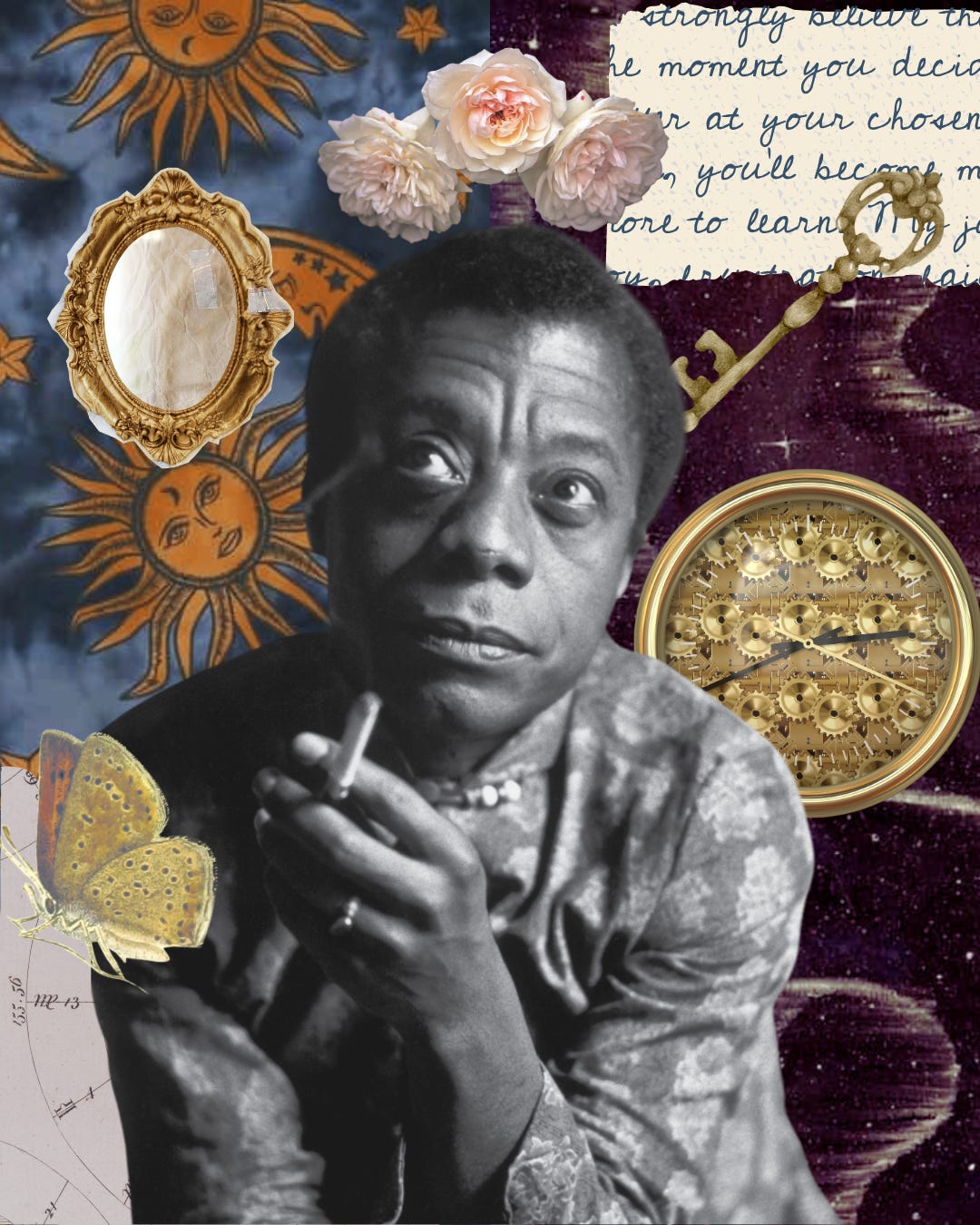
Like all artists, the writer arrives on this planet equipped with what James Baldwin identified as “this force which you didn’t ask for, and this destiny which you must accept.” That force is a kind of claircognizance about the world and how we, as humans occupying it, should evolve. This is the genesis of our warriorship—the hero’s journey every one of us is walking.
According to Joseph Campbell, ¹ “A hero is someone who has given his or her life to something bigger than oneself. The courage to face the trials to bring a whole new body of possibilities into the field of interpreted experience for other people to experience—that is the hero’s deed.” This is ultimately the goal of every writer. We meet each page with the desire to turn ourselves inside out—and to welcome all the small ego deaths that accompany it. Writers drink up the whole world—sometimes from a distance, sometimes while racing towards its center—and proclaim, “I am here, and this has moved me, and I want it to move you, too.”
This isn’t an easy process. Much is said and written about craft, about technicality and skill, and how we can improve in ways that will satisfy the capitalist inside us. But little is offered to writers regarding sustaining that “force” Baldwin spoke of, that very thing that cracks open the path of a hero’s journey.
When I write, the real work begins long before I find myself in front of my laptop. Writing, for me, is also:
Training my mind to stay present so I can decide what I want to reflect to the collective.
Learning to tell the truth—irresistibly—and weather the projections that arise in response to it.
Fighting to stay awake in a society that demonizes “wokeness:” constant deconstruction, endless questioning, grieving what is lost to enlightenment, celebrating what is found.
Embodying that which illuminates: allowing for an active expansion of the borders of my mental, spiritual, and emotional realms.
Writing involves a kind of spiritual athleticism, which may or may not drive you off the deep end. But you do it anyway, and you keep doing it because you must, because you know that someone out there needs to read the words you’ve written, or be shaped by your ideas, or inspired enough by them—if even for a moment—to contribute something to society that helps propel us forward, that helps us see and feel and know.
That is true warriorship.
And now that we know that, yes, writers, as articulated by Ta-Nehisi Coates, “[possess] the power to haunt people, to move people, to expand the brackets of humanity,” the question then becomes: what now? How do we actually hold this responsibility? What do we do with it once we acknowledge its weight?
Below are some practical steps I try to employ in my own life to keep me anchored inside the storm of that awareness:
Recognize the gravity of the moment. As we stand in the midst of global fascism (and a cultural landscape wherein our intellectual ancestors are exiting this realm and leaving behind a world of unchallenged superficiality), what would it mean for us, as writers, to rise to the occasion? An exercise I like to do when the clarity of this overwhelms me is to imagine myself as Luke Skywalker: born with the force, pulled into some larger mission by the threat of the empire, endeavoring to “through words, erode the claims of the powerful” (Coates). History is profoundly malleable at this moment, and each of us is imbued with the ability to shape the arc of it so it continues bending towards progress.
Resist the seduction of “it’s-not-that-deepism.” This increasingly-prevalent oddity—this quiet, steadfast dismissal of dog whistles (or even more blatant acts of racism), this persistent minimizing of basic empathy as laughable “wokeness,” this cry of “purity politics” in the face of people demanding more, this sudden, expansive shaming of those who dare to seek out a better world—I’ve taken to calling “veilkeeping.” ² It is the act of intentionally drawing people away from enlightenment, because resisting fascism is all-consuming, often unpleasant, and sometimes life-threatening. That’s why veilkeeping is so enticing. It feels easy. It offers the false promise of safety. But the writer sees into society, in all its beauty and ugliness, without turning away.
Keep a spiritual practice. This helps us maintain that sight without drowning in it. It doesn’t have to be something as dogmatic as going to Church or reading religious texts. It can be as simple as going for daily walks, keeping a journal, or night-driving. The goal is to let these practices serve as both routine shadow work and a space to cultivate mindfulness of our energy, beliefs, and desires. With this, we can resist the projections that follow truth-telling and the abyss of veilkeeping, because we’re in tune with ourselves; we’ve made a home within our bodies.
Remember that you are not alone. I get it. It’s hard. It’s isolating. This path requires a lot of us, and very few people on the outside can understand. But it’s important to remember that we are never alone. When we write, we carry the legacies of our ancestors (both those in blood and in literary spirit) with us, furthering their dreams, goals, and ideas to shape a fuller future. For instance, when I write, I am carrying the spirit of my foremothers and the legacies of Black writers and thinkers like Baldwin, bell hooks, Toni Morrison, Angela Davis, Audre Lorde, and Octavia Butler, whose words have guided, shaped, and inspired everything I do. I am not alone. I am in a tradition. ³
The beauty of writing lies in its ability to connect you to a patchwork of souls who are traversing similar roads, searching for fellow travelers to tell the truth, to illuminate the path when it gets dark, to remind them that they exist. Maybe that’s the modern essence of warriorship—not conquest, but awakening.
The rest, I suppose, I’ll untangle the next time I sit down to write.
Thank you for reading! If you’d like to support my work further, consider subscribing or checking me out on Threads or TikTok 🤍
notes:
I know Joseph Campbell sucks, but if I’m going to discuss The Hero’s Journey, sadly, I have to bring him up, lol.
veilkeeping (n.): The practice of (consciously or unconsciously) trivializing harmful systems, behaviors, or ideologies; the act of preserving illusions or maintaining supremacist, superficial understanding to ignore deeper psychological, social, or political truths.
This is no less than the third time I’ve quoted Ta-Nehisi Coates in this essay! “I am not alone. I am in a tradition” comes from The Message.
Your post was seen. Know that you touched someone out here in the ether. Thank you!
Good read 👏🏽